

Ross Jones
Visual Artist
Snells Beach, Northland
Ross Jones is a contemporary New Zealand painter known for his narrative-driven works that blend realism with subtle surrealism. His paintings often feature nostalgic scenes, vintage objects and everyday characters that appear familiar yet quietly enigmatic. Through these carefully composed moments, Jones invites viewers to pause and consider the stories unfolding within the image.
Working with a cinematic sense of composition and atmosphere, Jones builds scenes that feel both timeless and slightly dreamlike. Ordinary settings become stages for unexpected details, humour or symbolism, encouraging the viewer to interpret their own narrative. This balance between the recognisable and the surreal has become a defining characteristic of his work.
The limited edition prints available through Ashe present faithful reproductions of Jones’s original paintings, allowing collectors to experience the detail, storytelling and atmosphere of his work in large gallery-sized formats. Each print captures the distinctive tone and imagination that has made Ross Jones one of New Zealand’s most recognisable contemporary painters.
Ross Jones
Limited Edition Giclée Print on 310gsm Vellum Textured Fine Art Paper
Edition of 49
Print Dimension: 500×660mm
Paper Dimension: 640×860mm
Snells Beach, Northland
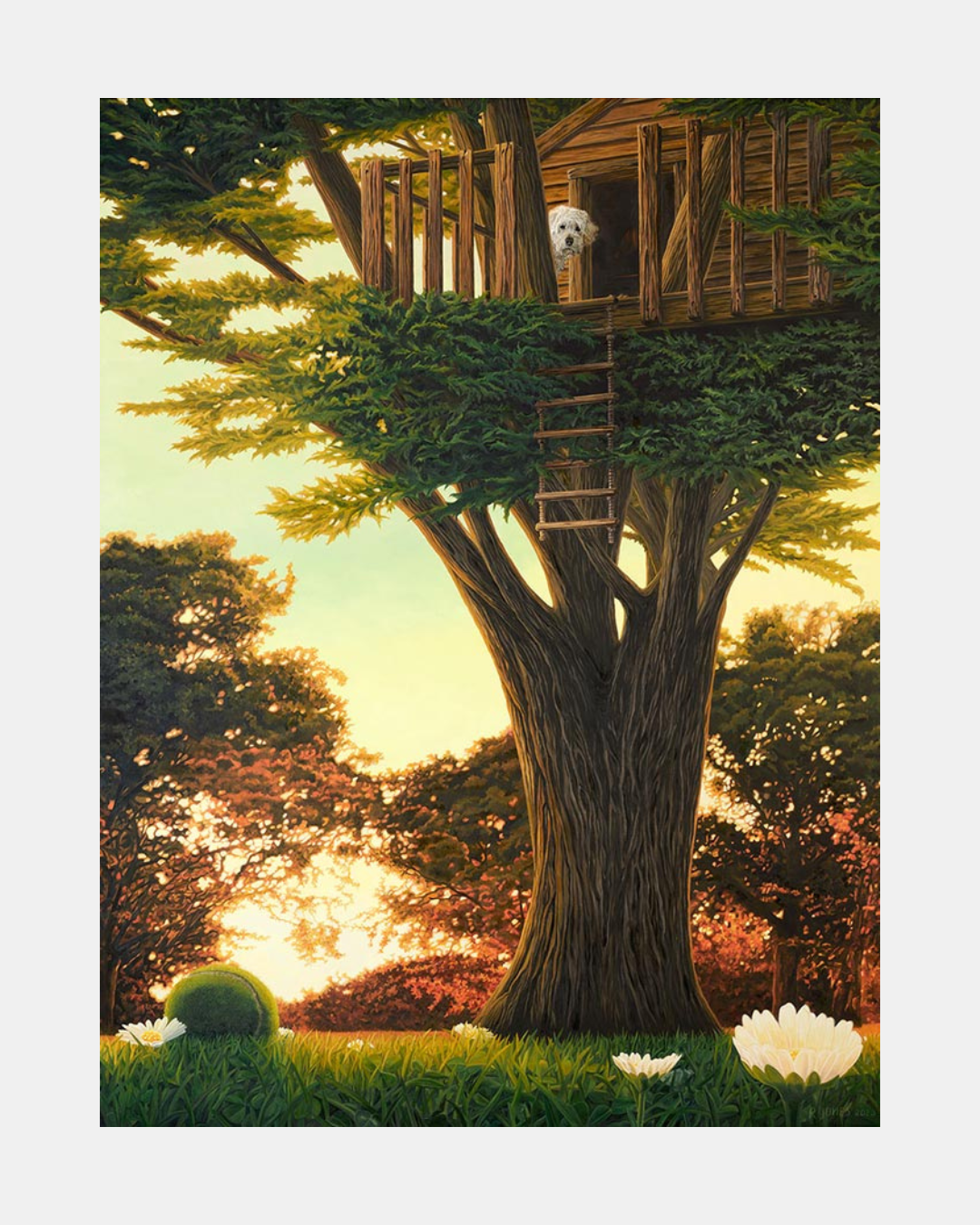
Alice is the guard dog, or at least that is what she tells herself. Perched high in a roughly built tree hut, she peers out through the slats, her white face framed by weathered timber and late-afternoon light. Below her, on the grass softened by daisies and long shadows, lies the object of her desire: a tennis ball. It rests innocently enough, glowing green against the fading day, close enough to see, far enough to be unreachable. The sun is sinking, and with it comes the quiet suggestion that this moment may not resolve itself before nightfall.
The title “Temptation” sets the tone immediately. Temptation is the pull towards something unwise, something irresistible, even when experience tells us how it will end. For Alice, temptation has a familiar shape, weight, and smell. The tennis ball is both a promise and a problem, a joy and an inevitable loss. She has loved many, and she has lost just as many. Her life could be measured not in years, but in balls found, balls destroyed, and balls mysteriously vanished. A kind of personal archive — a ball library — constantly being restocked and depleted.
The tree hut raises questions that the painting refuses to answer outright. How did Alice get up there? Was she lifted, did she climb, or did she simply will herself into this predicament through sheer enthusiasm? Is she standing guard, surveying her territory from above like a watchful sentry, or is she merely watching the world go by, temporarily trapped by her own curiosity? The ambiguity is deliberate. Alice is both watcher and watched, in control and completely undone by desire.
Light plays a quiet but crucial role. The warm glow of late afternoon wraps around the tree’s trunk and filters through the leaves, casting a sense of calm that contrasts with Alice’s inner conflict. Time feels suspended, yet moving inexorably forward. The ladder hangs uselessly beneath her, offering a route down that may as well not exist. The day is slipping away, and the ball remains untouched.
Alice’s relationship with the tennis ball began long ago, in the studio, during the painting of Fetch. As a puppy, she would sit patiently, watching from a corner as paint was applied, only to explode into motion the moment play was suggested. Since then, her skills have developed. She can strip the felt clean from a ball with surgical precision, crack its shell, and reduce it to fragments with unwavering focus. Destruction, for Alice, is not malice; it is simply part of the game.
She is also a performer. Alice delights in an audience. She will bounce a ball and catch it mid-air, grinning at the applause. She will “kick” a ball like a football, but only if she already has another one clamped triumphantly in her mouth. Rules, after all, are flexible things.
Temptation captures a pause between impulse and consequence. It is a portrait of longing, mischief, and self-inflicted dilemma. In Alice’s gaze is something deeply familiar: the knowledge that giving in may end badly, paired with the certainty that resisting would be far worse.
Flexible Payment Options
Supporting thoughtful collecting through personalised payment plans.
Ross Jones
Limited Edition Giclée Print on 310gsm Vellum Textured Fine Art Paper
Edition of 49
Print Dimension: 660×500mm
Framed in White with Art Glass UV99: 915×765mm
Snells Beach, Northland
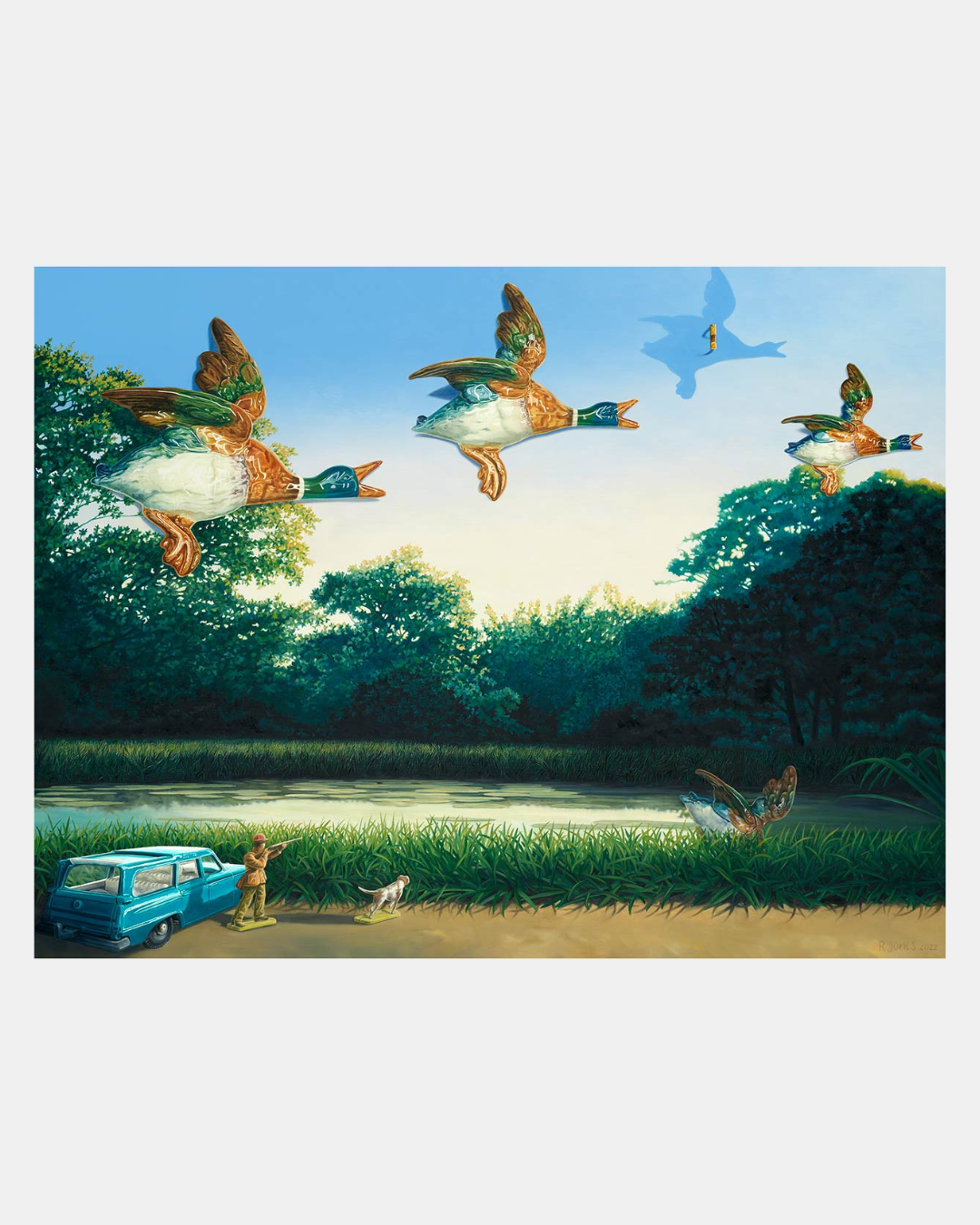
One person’s junk is another’s treasure, and in Prized Possessions that familiar phrase quietly underpins the entire scene. This painting steps into the curious, deeply personal world of collectors, where objects gather meaning far beyond their material worth. Here, realism and imagination meet in a playful act of trompe-l’œil, inviting the viewer to look twice, then linger, as memories begin to surface.
The eye is first drawn to the bottom left corner, where a Matchbox 42 Studebaker Estate Station Wagon sits confidently in the grass. It is small, unmistakably toy-sized, yet it carries the weight of childhood afternoons spent on the floor, inventing roads, stories, and destinations. Beside it stands a hunter and his loyal dog, frozen in the moment, forever poised for action. Together they form a tiny narrative of adventure and purpose, a reminder of how toys once allowed entire worlds to unfold within the boundaries of imagination.
Above them, the scene shifts. A flock of Beswick flying ducks glides effortlessly across the sky. At first glance, they appear free, airborne, alive. Yet their shadows betray them, anchoring their flight firmly to the wall behind. This visual tension—between motion and stillness, freedom and fixation—lies at the heart of collecting itself. These ducks are not merely decorative; they are icons, instantly recognisable to those who know them, and loaded with nostalgia for those who grew up with them on lounge walls and above fireplaces.
One duck has fallen. It rests in the lake below, separated from the others, its flight abruptly ended. The dog’s gaze suggests a retrieval may be imminent, reinforcing the idea of the endless hunt—collector and object locked in a perpetual chase. Nearby, a single brass picture hook remains, accompanied by a faint silhouette, marking the duck’s former place. Absence is made visible. Loss, too, becomes part of the collection.
There is hope here, however. The fallen duck may yet be repaired, perhaps using the ancient Japanese technique of Kintsugi, where breaks are not hidden but highlighted, transformed into something more valuable for having been damaged. In this small gesture, the painting nods to impermanence, fragility, and the quiet optimism of restoration.
The Beswick flying ducks themselves carry a rich history. Originating in Stoke-on-Trent and designed by freelance artist Mr Watkin, they were produced from 1938 through to the early 1970s in various sizes. Once commonplace, now cherished, they stand as symbols of mid-century craftsmanship and domestic pride. Their inclusion here is both homage and preservation.
Prized Possessions ultimately asks us to reflect on why we hold onto things. These objects—whether a toy car, a ceramic duck, or a childhood figurine—become vessels for memory, emotion, and identity. They remind us of who we were, where we’ve been, and what we valued along the way. In acknowledging their vulnerability, the painting gently reminds us of our own.
Flexible Payment Options
Supporting thoughtful collecting through personalised payment plans.
Ross Jones
Limited Edition Giclée Print on 310gsm Vellum Textured Fine Art Paper
Edition of 49
Print Dimension: 940×500mm
Paper Dimension: 1180×800mm
Snells Beach, Northland
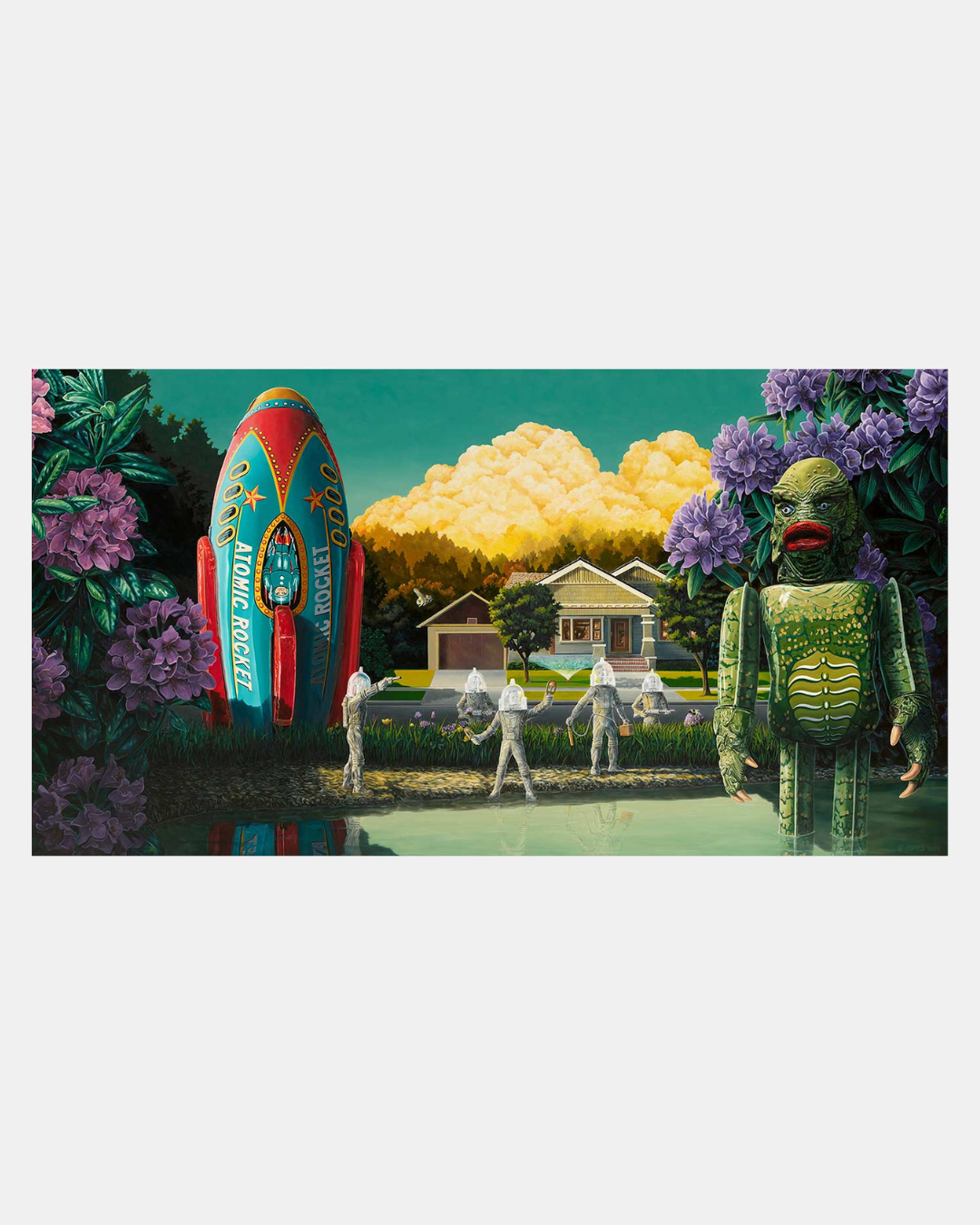
A toy can hold a whole universe in its hollow body. In Extinction, that universe is both vivid and doomed, as if childhood wonder has been drafted into service to carry the weight of the adult world. A strange creature — the last of its kind — stands on the right, half in water, half in garden, staring outward with the fixed expression of something that cannot understand why it is being watched. It is a toy, yes, but it is also a presence: vulnerable, singular, and already a relic.
Across the scene, a line of toy spacemen advances with that peculiar calm only toys can possess. Their clear bubble helmets catch the light like small moons. In their hands, they carry a mixture of instruments and guns — objects of inquiry and control, measurement and threat. Some hold devices that suggest surveying, sampling, or recording, while others grip weapons that turn the so-called expedition into something far more ominous. That detail shifts the story instantly. This is not simply exploration; it is extraction. It is not only curiosity; it is power.
The setting deepens the unease. A pristine suburban house sits in the middle distance: perfect lawn, tidy roofline, the quiet order of human comfort. Behind it rises a bank of cloud — thick, luminous, almost theatrical — like smoke made beautiful. Nature looms, but it is framed and contained. The sky is too perfect. The garden is too lush. Even the water reflects like glass. This is the kind of landscape we construct when we want to believe the world is stable, manageable, endlessly renewable.
But stability is an illusion, and the toys know it. The huge rocket on the left, painted in candy colours and stamped with bold lettering, is both celebration and warning. It promises escape, adventure, progress — all the bright ideas of the twentieth century — yet it also reads as a monument to human appetite. Rockets are made to leave, to conquer distance, to claim new ground. In the context of Extinction, it becomes a symbol of our restless urge to take more, to go further, without asking what gets left behind.
That is why the creature matters. It does not flee in motion; it flees by existing. It is cornered by the story itself. The painting echoes the question from the backstory: are the spacemen there to study or to destroy? The tragedy is that either answer can lead to the same end. To study can become to catalogue, to collect, to preserve, only after it is too late. To destroy can happen quietly, indirectly, through indifference, or through “progress” that does not pause to look behind itself.
Extinction rarely arrives as a single dramatic act. It happens by slow erosion — habitat reduced, water warmed, balance shifted — until “the last of its kind” becomes a sentence rather than a warning. The guns in the spacemen’s hands make that truth plain: this is a scene about domination, about the moment when knowledge and violence begin to resemble each other.
And yet, the painting’s power comes from its tenderness. These are toys: the rocket, the spacemen, the creature. They are the objects we once trusted to keep our fears small enough to hold. In Extinction, they are asked to do something harder — to remind us that wonder and loss are intertwined. The scene is beautiful, almost idyllic, and that beauty sharpens the grief. Because the world will still look lovely, even as it empties.
Extinction is a child’s story told with an adult’s knowledge. It asks us to decide what we are: curious visitors, careful guardians, or quiet destroyers. And it leaves us with the creature’s gaze — a toy’s stare that feels suddenly, painfully real.
Flexible Payment Options
Supporting thoughtful collecting through personalised payment plans.
Ross Jones
Gallery Edition Print
Limited Edition Giclée Print on 310gsm Vellum Textured Fine Art Paper
Edition of 49
Print Dimension: 500×660mm
Paper Dimension: 680×860mm
Snells Beach, Northland
First slip or leg slip? Are you a righty or a lefty? The question barely has time to settle before the ball is already on its way. Backyard cricket thrives on that uncertainty. It belongs to summer, to BBQ smoke drifting across the lawn, to long evenings when shadows stretch, and parents call out reminders that are politely ignored. Most kids have played it in one form or another. You never needed much: a bat, a ball, something to serve as stumps, at least two willing participants. The rest was negotiation.
In First Slip, the scene is deceptively calm. Three wooden stumps stand upright within a chalked rectangle in sunburnt grass. A bat lies grounded, its blade angled as though recently abandoned. To the right, a red cricket ball arcs away from the wicket, already committed to its fate. Upstairs, a window bears the unmistakable starburst of impact. The edge has been found. The slip cordon has been beaten. The consequences are immediate.
This is not a tennis ball, this is a proper cricket ball, the sort that makes a solid, unforgettable sound when it meets glass. Every backyard cricketer knows that sound. It travels faster than the ball itself. As kids, we understood the rules of the game, but we also understood the rules of the house. A broken window meant explanations, apologies, and a suspension of play. The thrill of the edge was always shadowed by the knowledge that Mum or Dad would soon appear at the door.
The setting is suburban and specific. Hydrangeas bloom heavily along the fence line. The green weatherboards glow in afternoon light. It could be anywhere, yet for me it returns to Mountain View Terrace in Ōtaki, our cul-de-sac pitch pressed into service whenever the weather allowed. The road became the wicket. Driveways were boundaries. Passing cars signalled a drinks break. That stretch of asphalt felt as sacred as any test ground. Mum and Dad still live there, but the cricket pitch has long since been retired.
Backyard rules were clear, even if unwritten. The pitch was two-thirds the length of whatever space we had. Stumps might be a rubbish bin if timber ones were unavailable. The bat could be any swingable length of wood; mine was carved from macrocarpa, uneven but treasured. Officially, the ball was often a tennis ball, chosen for diplomacy. Unofficially, and sometimes unwisely, a real cricket ball entered the contest.
The dog belonged to no one but itself. One-handed catches on the first bounce counted. Rebounds off sheds and roofs were fair play. Six-and-out applied if the neighbour’s fence was cleared in full. LBW was never, ever entertained. And winning? Winning was irrelevant. The game flexed around age and ability, around fading light and the smell of sausages on the grill.
First Slip lingers in the instant after miscalculation. The bat has done its job imperfectly. The ball has found the edge. The window has paid the price. It is a painting about risk, about bravado, about the thin line between triumph and trouble. Childhood was often lived on that line, where joy and consequence arrived almost simultaneously.
Here are a few well-known rules to get any game started.
Rule 1. The pitch shall be any strip around two-thirds the length of the family yard. We lived in a cul-de-sac, Mountain View Terrace, Ōtaki. Our cricket pitch was on the road. Mum and Dad still lived there, but the cricket pitch has been retired.
Rule 2. The stumps are a standard rubbish bin.
Rule 3. The bat, any swingable length of wood. I carved mine out of a piece of macrocarpa.
Rule 4. The official ball is a tennis ball.
Rule 5. The dog is on no one’s side but their own.
Rule 6. The batter may be caught on the first bounce, where the catch is taken one-handed. The rule also applies to rebounds off roofs and garden sheds.
Rule 7. Should the ball be hit on the full over the neighbour’s fence, the six-and-out rule applies.
Rule 8. No LBW EVER.
Rule 9. Who wins? How can you win a game that never ends?
Flexible Payment Options
Supporting thoughtful collecting through personalised payment plans.
Find out more.